Sunday, May 29, 2011

Going in Circles (Somewhere, Dogtooth, and Meek's Cutoff)


Picking a fight over a movie has its kicks, but part of the fun depends on the adversary. For example, Ali Arikan's recent Pirates of the Caribbean piece, which boldly upbraids a blockbuster predestined to suck, baits fans too inept to formulate a cogent argument, and has received a hearty round of Hurrah-for-Karamazovs from fellow blogger/critics who have all written immeasurably better things, strikes this reader as no more than a boring provocation. (There's a point to be made against the masses lining up like lemmings for the latest Hollywood refuse, but Ali's facile broadside doesn't come close to making it.) In contrast Eileen Jones, who occasionally plays the "moron" card as cheaply as Mr. Arikan rails about "cunts," nevertheless explains quite wittily and elegantly why Rob Marshall's movie fails (and how Gore Verbinski's maligned immediate predecessors succeeded far more than they were given credit for). Even better was Jones's challenge to critics of the Coen brothers' True Grit (and admirers of Hathaway's), which forges a fascinating link between the film, Portis's book, and Laughton's Night of the Hunter, and mounts a convincing defense that the Coens's body of work -- contrary to its critics and even a few admirers -- has been anything but cold.

Part of what makes an argument effective is the worthiness of its opponents; it's those same opponents, however, that can make crafting such an argument daunting. High-profile pictures -- The Dark Knight, The Tree of Life -- breed a religious fanaticism in their devotees that can be difficult (and tiresome) to deal with, but Nolanoids and Malickheads typically have a mass facelessness -- like the torch-and-pitchfork crowd at the end of Night of the Hunter -- that give their onslaughts a welcome dash of the ridiculous. Find yourself disliking a smaller film like Meek's Cutoff, Somewhere, or Dogtooth, however, and you may find yourself up against formidable admirers of one, two or all three of those movies, often critics you respect. Movies like these are invariably described by their fans as "challenging": they make the viewer work a little to understand them. I'm all for a little audience effort (Certified Copy being a recent example), but my litmus test ultimately boils down to this: Are you working harder than the movie is to express itself? Kubrick and Malick, Kiarostami and the Coens can all be difficult, but I always have the impression that they know what their movies are about. I'm never left with the sense that they're giving anything less than their all.

The least offensive of the aforementioned threesome, Somewhere is Sofia Coppola's latest non-movie about characters stuck in mind-numbing stasis. As in Lost in Translation and Marie Antoinette, Coppola traces celebrity and affluence as the causes of this condition, and I do feel that some critics of her work are off-base by begrudging her for writing what she knows. The problem with her films isn't their insularity, but what she puts into them -- dying stars inside of black holes. Lost in Translation overcome many of its flaws because Bill Murray, as a movie star adrift in a strange land, so beautifully rendered charm out of ennui. (Scarlett Johansson, not so much.) Somewhere casts an inexpressive B-list actor (Stephen Dorff) as a fame-fatigued A-lister, and fails to make his estrangement -- from his daughter (Elle Fanning), from himself -- even remotely as persuasive. (Imagine what Murray would have done with the scene where Dorff's face becomes frozen under layers of movie makeup and you have a semblance of what's missing.) The movie has some affecting moments that evolve from long silences: an ice-skating practice; an older gentleman's guitar solo that captivates the hero more than an assembly of pole-dancers ever could. Inevitably, though, I have qualms about a filmmaker who believes that the best way to convey inertia is via an inert approach.

Somewhere looks downright admirable compared to Dogtooth, the acclaimed Greek black comedy about a father (Christos Stergioglou) who raises his three grown-up children on an isolated family estate that they are forbidden to leave. The kids, all maladjusted blanks with misbegotten vocabularies, are "protected" from the outside world -- represented by the patrarch's place of business, a dreary factory -- yet chaos emerges via a young woman (Anna Kalaitzidou) hired to prostitute herself to the older adolescent son (Hristos Passalis) and, more importantly, contraband videocassettes of Rocky and Flashdance that inspire the eldest daughter (Aggeliki Papoulia) to flailing rebellion. Steven Boone has taught me more about visual syntax than any film critic around, but I must respectfully disagree with his assertion that the lead-pipe directorial style of Giorgos Lanthimos adds up to anything other than a thudding hollowness at the narrative's core. More than one admirer has compared Dogtooth to the best of Luis Bunuel (puh-leeze!), but the surrealist master always posited his malicious contraptions within a larger sociopolitical framework and made his targets worthy of their punishments. The cheap, empty cruelty of Dogtooth is closer in spirit to the early work of Michael Haneke and is every bit as despicable.

Which brings us to Meek's Cutoff, the most recent widely-praised film by my least favorite current filmmaker. The previous efforts of Kelly Reichardt, Old Joy and Wendy and Lucy, approach modern malaise from the opposite end of Sofia Coppola's economic spectrum: For Reichardt, it's poverty that's the cause of society's ills, a perfectly valid worldview negated by the filmmaker's insistence that the lower-class live out every interaction of their lives in staggering torpor. The sun not only never shines in her monotonous Pacific Northwest milieu, the characters never laugh, never crack a joke or a smile, never express or act out a subversive thought. When a character makes a rare act of selflessness, like the security guard who gives Michelle Williams money in Wendy and Lucy, he's made to look like a dunce.

I had braced myself for more of the same with Meek's Cutoff, her period-piece foray into 19th-century pioneering, so it was seductive to be confronted by sunlit vistas of an expansive Oregon desert, as ravishing as they are treacherous. (The peerless cinematography is by Chris Blauvelt, a relative newcomer with camera-operating credits for David Fincher and Gus Van Sant.) Although Reichardt's sub-laconic, micro-minimalist style works far better coming out of the mouths and registering on the faces of 1845 settlers, her ensemble is more varied this time out. (There's even, my God, a joke or two, albeit the biggest laugh is derived from an opening title card that reads "A Primitive Nerd Production.") Michelle Williams provides a stronger moral center than she was allowed in Wendy and Lucy; Paul Dano's precise enunciation is as hypnotic as it was in There Will Be Blood (hard to believe his breakout role, in Little Miss Sunshine, was a character who refused to speak); Shirley Henderson's dreamy British diction is a constant source of amusement. The most colorful character is the titular Stephen Meek (a bearded Bruce Greenwood), a posturing, self-aggrandizing guide who has persuaded (perhaps disingenuously) this handful of pioneer men and women to abandon the larger wagon train and follow him to a suitable terrain to call home.

The opening third of Meek's Cutoff casts such a spell I had nearly convinced myself that Reichardt had wrecked my thesis for this post. Eventually, however, her dunderheaded storytelling instincts kick in. The lost pioneers capture a solitary Native American (Ron Rondeaux), and much argumentation ensues over whether the man should be killed (Meek's preference) or used as a guide to a desperately-needed water source (the Williams/Patton option). I've read reviews describing Meek's Cutoff as an allegory for Bush's failed leadership in the Iraq War; if that was the intent, it's muddled by the fact that we never see Meek persuade anyone to do anything. His con -- if that's what it is -- occurs before the narrative opens. The movie is more about the perils of following: yet that too is hampered because the decision to follow the Cayuse Indian has no consequences one way or another. His motives are depicted as ambiguously as Meek's, no matter how much blind faith Williams puts into him. (Stabs at fragmented communication between the settlers and the Cayuse are about as convincing as similar scenes in The Ewok Adventure.)

I know, not every movie needs a payoff. To make the whole Waiting for Godot thing work, though, an artist has to captivate by other means, and Reichardt's ideas are too half-baked to warrant such high regard. She sets up a potentially riveting narrative -- growing suspicion that Meek is all bluster, mounting hysteria that the Cayuse is leading them into a trap -- and abandons it not due to the demands of the story, but because, I suspect, she feels above such niceties. Too bad. Despite succumbing to her worst impulses, Kelly Reichardt has come dangerously close to making a good movie. Maybe next time.

Sunday, May 15, 2011

Too Many Secrets (Farewell and The Tourist)


Farewell (2010) tells a great story from the ground up: In the early 1980s, during the last pinnacle of the Cold War, a high-level Russian intelligence agent passes state secrets to a low-level French operative, leading ultimately to the downfall of the Soviet Union. The Russian, Sergei Gregoriev (Emir Kusturica), is a fortysomething epicurean, gregarious and reckless, in possession of a fed-up, middle-aged wife, an obsessed mistress, and a teenage son with an appreciation for "decadent Western music." The Frenchman, Pierre Froment (Guillaume Canet), is a thirtyish intellectual, whose ambition and timidity pull him in opposite directions and threaten to estrange him from his own young wife and infant children. The movie begins in media res (finally, an excuse to use that phrase!), with Sergei waiting for Pierre while ensconced in the back-seat shadows of the latter's car. It's an opening reminiscent of Alan Pakula's work with Gordon Willis, yet where Farewell departs from its forbearers in the genre is Sergei and Pierre choose to conspire not at a loading dock or in a underground garage but rather directly outside a public event (a circus performance featuring one of Pierre's daughters). The hiding-in-plain-sight joke turns into a running gag, as the pair continue (at Sergei's behest) to rendezvous in one public area after another, exchanging government records during the harsh light of day. Sergei's scheme is so counterintuitive that his colleagues in the Russian intelligentsia overlook it entirely; it's so mundane that it takes a while for the French and American presidents -- Mitterrand (Phillippe Magnan) and Reagan (Fred Ward) -- to realize the gold mine of information that's landed in their laps.

This has all the makings of a terrific thriller, a human-scaled epic out of le Carre, so it's puzzling that Farewell never quite grips as a satisfying whole. The director, Christian Carion, works with an ambitiousness that exceeds both his budget and skill. Individual sequences, like a white-knuckler at a border crossing, are deftly staged. But there's a lack of momentum from one scene into the next; even a montage late in the movie featuring the international rounding-up of covert KGB agents (one of them played in a wordless cameo by Diane Kruger) lacks a sense of how this humdrum operation affects the bigger picture. Inconsistency also plagues the performances. Kusturica (who is a Serbian film director) plays Sergei like a Russkie Brendan Gleeson, expansive, flawed and soulful, whose commitment toward giving his son a brighter future is the catalyst for his actions. Canet (perhaps also better known as a director, namely of the superb French thriller Tell No One) renders Pierre an effective everyman, less goal-driven than Sergei to "change the world" than he is at bucking for promotion, yet increasingly terrified of getting caught, getting killed, or losing his family. On the downside, Fred Ward's turn as a bizarrely engaged Ronald Reagan is a constant source of distraction, and reminded me of Phil Hartman's priceless countermythical impression on Saturday Night Live: "I've got to do everything by myself!"

Florian Henckel von Donnersmarck makes up for the cunning of his surveillance experts in his last film, The Lives of Others, with a vengeance in the first five minutes of The Tourist (2010), opening with a laughably conspicuous black panel van tailing Angelina Jolie from about ten feet behind. Jolie plays an English mystery woman (a secret agent, or femme fatale, or something) named Elise Clifton-Ward, who shows her knack for undercover work by appearing in magazine-cover attire and burning a surreptitious note dropped at her table in an outdoor Parisian cafe. A head of British intelligence (Paul Bettany, spending the movie glaring at computer screens and barking orders into microphones) commands his team to Get That Note!, and they tail their leisurely-paced high-heeled target down the street before losing her in a subway tunnel. I was hoping to see Jolie give her pursuers the slip through a gaggle of nuns, but von Donnersmarck sadly lacks a flair for the ridiculous.

Rather, The Tourist doesn't seem to know it's ridiculous. Or perhaps the movie senses this quality (there is a lingering whiff of desperation) but won't embrace it. Obviously von Donnersmarck wanted to make a lighthearted Hitchcockian travelogue -- To Catch a Thief, et al. -- and that kind of movie would have been more than welcome, but what he came up with instead can only be described as laboriously breezy. (Come to think of it, To Catch a Thief wasn't that great in the first place.) On a train for Venice, Elise meets Frank Tupelo (good sport Johnny Depp), a mild-mannered American tourist who becomes her dupe as she plots to evade both the clueless Brits and a ham-fisted gangster in order to rendezvous with her white-collar thief-lover. The leads have zilch chemistry, the chase scenes move at half-speed, and the director appears to have advised every male actor in the cast to react to Jolie's entrances like a cartoon wolf clubbing his own head with a mallet. No question she's still a looker (though the botox is starting to get in the way), but it's a weird case of overselling from a filmmaker whose debut was breathtakingly calibrated. The Tourist is a comatose non-starter.

Saturday, April 30, 2011

Ebertfest Day 3: 45365, Me and Orson Welles, Only You


"I don't think people read film criticism. I think people read film critics." - Matt Z. Seitz

This day, the Third of Ebertfest, is my last in Champaign-Urbana for the week, though the festivities will continue through Saturday and early Sunday. Saturday's screenings include a couple of documentaries I'm not that interested in (A Small Act and Life, Above All) and a pair of fictional films that I've already seen (Leaves of Grass and I Am Love). I have no major regrets about bolting a day early, apart from missing Tilda Swinton's appearance on Saturday evening. I'll see her at our wedding, though. And it would have been nice to catch the closing film, Louder Than a Bomb, co-directed by Jon Siskel, nephew of the great Gene. I'll extend my visit next year.

Additionally, I will plan on booking my lodgings early enough to stay at the Illini Union, albeit my lateness in doing so this year may have caught me an unintended break. For reasons many C-U denizens have trouble comprehending, the annual Illini Marathon is being held on Saturday, overlapping with Ebertfest and adding another 20,000 visitors to the 14K that the Festival already provides. Traffic will reportedly be closed through much of campus, where the marathon passes through, but because the Hamptom lies just north of the race, it looks like I may be able to get home.

I've neglected to mention the panels here at Ebertfest, which have been quite enjoyable despite the punishing early morning start times. The Thursday 9 a.m. panel, titled "Personal Stories in Film," featured some interesting discussion -- particularly from Michael Phillips and Kristin Thompson -- on the tension between personal and commercial product in cinema and served as a prelude to a few of the Festival's offerings. After the panel I spoke with Thompson, a professor at the University of Wisconsin-Madison and, along with her husband David Bordwell (who was unfortunately ill and unable to attend), co-proprietor of the brilliant blog Observations on Film Art, and told her the high regard that readers (myself included) have for her and Bordwell's stimulating online discourses. She said that that was good to hear, that at times she and David felt like they were writing in a void. Yet when I suggested that opening the comments on their site might remedy that feeling, Thompson recoiled like I'd offered her a snake. "Oh, no no no no..." she said. It never ceases to amaze me how smart people consistently fail to take advantage of opportunities of their own creation.

The first Friday morning panel, "Ebert Presents: Reinventing the TV Show in the Digital Age," was quite good considering how hungover most of the panelists appeared. Moderated by Chaz Ebert, with Roger in attendance, the folks at the table featured the stars of the new "At the Movies," the very tall Ignatiy Vishnevestsky and the very short Christy Lemire, along with a rogue's gallery of contributors that included David Poland (whose laptop appeared to be attached by umbilical cord), Dann Gire, and Matt Zoller Seitz. However, the topic became more about the state of film criticism itself when Gire (whose name rhymes with either "fear" or "dire") went off on an apocalyptic tangent about the Evils of Rotten Tomatoes, and Matt responded with the quote that kicks off this post. After Christy-L and Iggy-V offered some climactic banter, I joined the congregation at the microphone and eventually asked the panel if they ever feel pressure to conform to the general consensus about a movie. I was pleased that Chaz liked my question so much that she asked it to every panelists down the table, though it ran time over enough for one of the Ebertfest people to warn Chaz that "Norman Jewison is waiting" for the next discussion to start.

Finally, the movies themselves began with 45365 (2009), a lovely documentary from brothers Bill and Turner Ross about a year in their hometown of Sidney, Ohio. I don't know if it was intended, but the film has an Altmanesque quality, from the large ensemble to the overlapping dialogue to frequent use of the pan-and-zoom. (I was also reminded of Do The Right Thing, in the central figure of a white DJ equivalent to Mister Senor Love Daddy.) Outside afterwards, an attendee complained that the movie didn't show enough economic hardship. I would counter that the Ross Bros are not miserabilists but impressionists; I'm not sure what other impression one could take from the quietly affecting sequence of a man's prison sentence beginning by being cuffed and chained by a polite court officer, but I definitely have mine.

The day concluded with a pair of minor films from major filmmakers, both of whom were in attendance. Richard Linklater's Me and Orson Welles (2008), starring Zac Efron as an eager teenager who partakes in Welles's 1937 production of Julius Caesar, is one of those movies that thinks the most authentic way to depict "The 30s" is by goosing us with nonstop Big Band music and encouraging its cast to talk archly out of the sides of their mouths like a high school production of Give My Regards To Broadway. Linklater's movie is a harmless trifle (strictly Newton Boys territory); Christian McKnight's terrific performance as Welles, more than that.

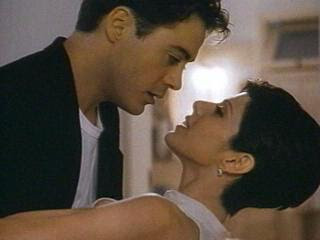
Norman Jewison's Only You (1994), also an inoffensive time-waster, stars Marisa Tomei as a true-love free-spirit nonsensically about to marry a boring podiatrist until she encounters Robert Downey, Jr. in Italy and believes him to be The One. Jewison's foray into Nora Ephron territory adds to this rough outline a couple of decent twists that I won't spoil for anyone, and whenever the plot starts to flatline Bonnie Hunt, as Tomei's unhappily married sister-in-law, pops in to ad-lib a nifty zinger. Tomei's comic timing, though, is a half-beat too slow for Downey (and a full beat too slow for Hunt), and the two never really connect. Needless to say, the director of In the Heat of the Night and Moonstruck has done better things, but it was worth watching the movie just to see Jewison in person (both at the earlier panel and the post-screening Q&A), his memory slipping a little but otherwise looking pretty damned fit for 84 years old.

Ebert's own health sort of became the elephant in the room, one which I want to briefly address. Sitting next to me at one screening was a young woman named Jenny, who confessed that she decided to come to Ebertfest all the way from Washington, D.C. because she didn't know how much time he might have left. She apologized if that sounded badly, and I apologize if it comes across as morbid on the page, but I told her that I understood what she meant. Roger may well outlive all of us, clearly the last thing he wants is to be sentimentalized or pitied, and he won't be getting either from me. Having said that, I think it's good that people feel compelled to celebrate him now -- to celebrate movies with him, to let him know how much he means to them, has meant to them for a long time.

Plenty of articles lately have attributed the loss of Ebert's speaking voice with his "finding a voice" online, but what's never recognized is that Roger has always had an online presence. He created his own online film forum on CompuServe in the late 90s (I know, I was there [briefly]), when nearly every other print critic was pooh-poohing the Internet. As Richard Linklater reminded us, Roger has always been fascinated by technology as well: he said he met Ebert 25 years ago at a college in Hawaii, watched him use a laser-disc copy of Citizen Kane to analyze the film with students frame-by-frame. Linklater called it "my equivalent of film school."

What has made Roger Ebert so vital to film criticism for more than 40 years is his ability to employ new technology (television, laser-disc, the Internet, CereProc voice software) in such a way that he makes his real-world presence even more essential. Yet many film critics and film scholars still don't get it. They think it's an either-or scenario -- choose tradition or choose the future -- and so they become Little Dutch Boys with their fingers in the dyke. Having just seen eight movies over an exhausting three days, I can truly say that I respect what film critics do more than ever, and I'll be more understanding the next time one of them makes a mistake. But I also believe that film critics continue to be their own worst enemies, that if they would stop whining about Rotten Tomatoes and circling the wagons every time a gaggle of immature prepubescents takes umbrage at something they've written -- that if they'd stop embracing martyrdom and start connecting with a potential audience, then Yes, Virginia, some of them just may find their voices too.

Ebertfest Day 2: Umberto D., My Dog Tulip, and Tiny Furniture


At the end of Day One at Ebertfest, I left you stranded with Loud Laughing Guy up in the Virginia Theatre's balcony, having successfully given him the slip. Or so I thought. On the second day, alas, he tracked me down, from the balcony to the downstairs right corner for the evening screening of Tiny Furniture. Remember Night Court? Remember the really obnoxious solo male guffawer that penetrated through the more canned audience laughter? I swear it's the same guy: HAW HAW HAW HAW! In principle there was nothing odd about the laughing -- Tiny Furniture is a very funny movie. It was the fact that he was often laughing during the intervals between the jokes that gave those of us around him pause.

But I digress. Most of the attendees have been wonderful (even if a few middle-aged and elderly moviegoers continue to counter the myth that teenagers are the only ones ruining movies by talking and texting). My own IU Cinema hat -- the same kind as the one I gave Roger -- attracted the attention of a few visiting Hoosiers at the first morning panel discussion: "Personal Stories in Film." I also met for the first time a few fellow online bloggers: Kenji Fujishima, Odie Henderson, and a bleary-eyed Matt Zoller Seitz. Matt was getting coffee right before the Thursday afternoon screening of My Dog Tulip. "I'm leading the Q&A with the directors after the film," he explained. "Oh," I said, "have you seen it before?" "No," he admitted. "So I'll be watching very closely."

I have little to say about the day's first movie, Umberto D., because there's nothing possibly new that's left to say about it (De Sica, Neorealism, cute dog tricks). And I have unfortunately little to say that's nice about My Dog Tulip, which essentially stretches out a poop joke over 83 interminable minutes. Actually, that's not fair: piss, vomit, and doggie fornicating also figure prominently -- over and over and over and over again -- in this R-rated canine cartoon. I haven't read J. R. Ackerley's novel on which Paul and Sandra Fierlinger's animated film is based, but what may have been charming on the page is deeply tedious onscreen, even when narrated by Christopher Plummer. I feel badly writing that, since the Fierlingers came across in the Q&A as committed artists who made the movie they wanted to make. It's just not the movie I wanted to see.

Easily the best new film I've seen at Ebertfest so far is the one I dreaded the most: Lena Dunham's Tiny Furniture, which has enjoyed national festival success and experienced an intense backlash with a rapid speed appropriate to its YouTube Generation milieu. Dunham wrote, directed, and stars in the picture as Aura, a recent graduate of an Ohio college who returns to live at her mother's swanky New York apartment (a key character played by her real mother, Grace Dunham). As a screenwriter, Dunham has a wonderful ear: one character, a relentless social climber, is described as the kind of person "who would attend the opening of a fucking envelope." What amazed me, however, was her eye: Rather than shake the camera around to create the illusion of reality, Dunham nails it to a tripod and demonstrates what the best filmmakers all possess -- an intuitive sense of physical space. Tiny Furniture is really about the relationship between one's physical and mental spaces: the feeling of being too big to stay in your room, yet too small to venture out in the world. It hooked me right away, but several folks around me hated the movie with the kind of hostility that invites a dimestore psychological interpretation. Something about Lena Dunham -- her gender, her privilege, and perhaps most of all, her plain-Jane looks -- seems to get to some people, as though thinking, How dare she? I say talent is talent, in whomever and wherever it arises. Tiny Furniture isn't a great movie. But it is a great first movie, and I look forward to seeing what she does next.

Next: Day 3, with 45635, Me and Orson Welles, and Only You.

Thursday, April 28, 2011

Ebertfest Day 1: Metropolis and Natural Selection


"When we started out (with our first film project), we went in with the idea that everybody has a story to tell. And by the end, we learned, not everybody does."
-Sandra Fierlinger, co-director of My Dog Tulip,
with the funniest quote from Ebertfest so far

Also known as the Roger Ebert Overlooked Film Festival, this year marks the 13th annual Ebertfest held in Champaign-Urbana, Illinois, and my first foray to both the festival (hell, to any film festival) and to Roger's hometown. Venues are held in two locations: screenings at The Virginia Theatre on Park Avenue in downtown Champaign; panel discussions at the Illini Union on the University of Illinois campus. For future attendees it should be advised that the Union Hotel is also the prime place for lodgings; I was too late in making reservations, however, and am staying instead at the Hampton in Urbana on the northern tip of campus -- which lacked hot water in this morning's shower and possesses a certain hard-edged charm. (When I asked the front-desk person if there were any shuttles to the Theatre, she replied with a curt, "No." Not any alternative suggestions for bus transport, nor offers to call a cab. Just "No.") But the hotel does have the benefit of being within a ten-minute walk of the Union and an equally short drive to a downtown parking garage only a couple blocks from the Virginia. Parking was one of my biggest concerns coming in, but it's surprisingly cheap and easy.

Opening night proved to be a very enjoyable (if very late) evening that deviated from the regular program, Chaz Ebert explained in her introductory remarks, in that two films were shown instead of the traditional one 70mm event: Fritz Lang's classic Metropolis; and last month's SXSW festival winner Natural Selection. This was actually the second time in two months that I'd seen the newly restored Metropolis, the first being in February at Indiana University with music from a 17-piece Jacobs School student orchestra. The Ebertfest version was scored by the Alloy Orchestra, a three-person unit renowned for their silent-film music that's heavy on percussion and electronica and banging pots and pans. This seems to be a minority opinion here, but I found their approach a little grating, while obviously passionate and ambitious. I'm not sure, though, that sound effects are needed for every single action and gesture in the movie. I thought that the more traditionally classical performance by the Jake, the first use of the "new" sheet music (based on the formerly lost original score by Gottfried Huppertz), was more effective. Either way, Metropolis is still a stunning experience. An indestructible classic, if the movie could survive Giorgio Moroder, it can survive anything.

The Ebert-led jury in Austin slathered Natural Selection with prizes, and it's easy to see why a good Darwinist like Roger flipped over it. Robbie Pickering's road comedy about a fundamentalist housewife's search for her sperm-donating husband's son spends its first half scoring easy points on the Christian right and its second half doubling back for some hasty deepening. (The Ebertfest audience ate it up, especially Loud Laughing Guy sitting behind me in the balcony: "HAW HAW HAW HAW!") It's always tricky with a target like this, not because I think it's an undeserving topic for satire, but I guess I want a filmmaker to challenge his own assumptions, to explore where these characters are coming from, and depicting a minister who swears and says "goddamn" a lot seems less than that. Yet, somehow, my dislike for the movie transformed almost imperceptibly into delight: Pickering has a knack for tightening screwball comic logic, so that the movie becomes a sort of Preston Sturges film about evangelicals; and he's doubly blessed having Rachael Harris as his lead. The Ebertfest program notes assure us that "we'll be hearing a lot about Robbie Pickering" this year, but rest assured instead that it's Harris (who has been in attendance this week, along with Pickering) who's going to be the topic of conversation. She's phenomenal, and it was an honor to shake her hand and tell her so.

Speaking of handshakes, Roger Ebert, as reported, has a grip like a vise. After thirty years of reading his books and watching the guy on television, plus approximately fifteen years of occasional correspondence (I never expect him to remember who I am, but he at least takes the trouble to pretend he does), this was the first time I'd met him face-to-face. I'd also been asked by the IU Cinema's director to present him with a gift: a Cinema cap. Opportunity knocked in the Theatre lobby immediately following the Metropolis screening: the witty bon-mot I'd had planned, something about accepting a gift from a Big 10 rival (HAW HAW HAW HAW!), promptly dissipated, and I babbled something semi-intelligible instead. No matter. He shook my hand again, then placed his hand over his heart.

Coming Next: Day 2, Umberto D., My Dog Tulip, and Tiny Furniture.

Saturday, April 23, 2011

Parental Discretion (The Fighter, Never Let Me Go, and Wall Street: Money Never Sleeps)


Catching up to the Winter (2010) releases, as I do inevitably every Spring (2011), always yields belated Christmas gifts of confirmations and surprises. In the case of the latter, I had avoided The Fighter because the idea of a go-for-it Oscar-bait true-story boxing movie shot with epileptic camerawork and performed by a hollering Boston-accented cast seemed almost as appealing as a nail drilled through my head -- indeed, the director, David O. Russell, took up the project only after his latest unbankable black comedy on that very subject (Nailed, starring Jessica Alba), was aborted by the studio. I should have had more faith, though. Beantown stepbrothers Micky Ward (Mark Wahlberg) and Dicky Eklund (Christian Bale) are indeed followed by a camera crew filming an HBO documentary, but Russell keeps the integrity of his own superb framing, maintains his own humorously-askanced yet emotionally-invested point-of-view.

Russell's approach is beautifully in-synch with his star, Wahlberg, who occupies the still center of a familial storm that includes drug-addled Dicky, emasculated father George (Jack McGee), seven scary sisters and an even more terrifying matriarch Alice (Melissa Leo). Dicky, a former welterweight who once gave Sugar Ray Leonard a run for his money, is the central figure of the HBO doc, and for a while this conceals the predictability of Micky's sports-triumph arc, adds a layer of comedy and complication to what becomes ultimately Micky's story. At 31, Micky, a plowhorse junior welterweight, knows that his days as a contender are nearing an end, and is forced to consider whether his loyalty to what his advising barmaid girlfriend Charlene (Amy Adams) and encroaching boxing professionals call "the circus" -- his brother-trainer and mother-manager -- is keeping him from fulfilling his potential.

The Fighter is Russell's most commercial movie since Three Kings (1999), and just as that film made compromises to the war genre (including an upbeat ending that the director himself has expressed misgivings about), so too does this one embrace sports movie cliches. The boxing matches, filmed in the same ESPN style in which they were originally telecast, offer little strategy beyond the dubious Rocky notion that getting beaten to a pulp makes you stronger. Fortunately, The Fighter also marks a return to the comedies of family suffocation with which Russell launched his career. Both Spanking the Monkey (1994) and Flirting with Disaster (1996) are about characters trapped in families they are desperate to escape; The Fighter extends this theme into the effect of parents and siblings on one's vocation, with Alice and Dicky depicted as hyper-supportive, well-meaning individuals who don't know when to back off. The histrionics of Bale and Leo in their respective roles have come under some criticism, and while I found the latter's Oscar campaign particularly odious, I was surprised by how much I enjoyed their performances. They play their characters as constantly circling, negatively-charged electrons, no doubt precisely what their director had in mind. David O. Russell may be a thug, a bully, and a maniac, but The Fighter shows, once again, that he's also enough of an artist to examine how he got there.

If nothing else, the over-the-top dynamism of The Fighter makes a refreshing tonic to Never Let Me Go, a drizzly, plinky thing about a trio of nearly-human clones who accept a cruel fate as organ-donors the jolly-old-English way: because to revolt would be rude. Adapting a reportedly hugely popular 2005 novel (I have to take that at its word more and more these days) by Kazuo Ishiguro, Danny Boyle's favorite screenwriter Alex Garland fashions a common love triangle whose uncommon elements are barely emphasized or explored. At the telegraphically-named Hailsham boarding school, young Harry, Ron and Hermione Kathy, Tommy and Ruth become, at various turns, friends, love interests, and romantic rivals; yet not even growing up to be played by well-bred twentysomething movie stars like Carey Mulligan, Andrew Garfield, and Keira Knightley is enough to deter their destinies as "donors." True love may, possibly, be grounds for a "deferral," a rumored pardon to be granted by the enigmatic school headmaster (an underused Charlotte Rampling). But, alas, Kathy and Tommy are kept apart by Ruth's machinations, until a reunion years later gives them One Last Chance.

Ishiguro also wrote The Remains of the Day, adapted into a fine 1993 film starring Anthony Hopkins and Emma Thompson. The Merchant/Ivory imprimatur was often misinterpreted as mannered: their best work (including Remains) conveyed the tension between stoic appearances and emotions roiling beneath the surface. Never Let Me Go is too refined to roil. The director, Mark Romanek, has had a long career with the likes of Madonna and The Red Hot Chili Peppers(not to mention a foray into feature films with the terrible Robin Williams stalker-picture One Hour Photo); I never thought I'd use this as a criticism, but he brings nothing that he's learned from directing music videos to the table. Scenes are static; the editing is uninspired; the score, by Rachel Portman, is the same piano-based tuneage she always delivers (Emma, The Cider House Rules, Chocolat, et al.). Mulligan and Garfield are pleasant as star-crossed Kathy and Tommy, Knightley effectively unpleasant as the scheming Ruth. Although she could have easily played the lead, Knightley was shrewd to take a smaller part that pays bigger dividends -- a jealous, insecure young woman whose motives are so ambiguous that her final act of manipulation could be taken either way as an act of penance or vengeance. It's the kind of unsympathetic performance in a drearily tasteful movie that would have made Pauline Kael pull her finger out of her throat in admiration.

Kael once quipped that she retired because "The thought of sitting through another Oliver Stone movie was too much to bear." That was during Stone's early-90s age of agitprop, with JFK, Natural Born Killers, and Nixon sending film critics running from early screenings to the nearest CNN panel discussion. Yet modern American cinema's most controversial director has been accused more recently of toothlessness, which Wall Street: Money Never Sleeps does sadly little to dispel. It's a deeply strange movie, with an odd piggy-back structure that keeps Gordon Gekko, its ostensible uber-villain and sole reason for existence, on the sidelines before suddenly vaulting him to the top of the pyramid. (The easily distracted screenplay was co-written, ironically, by former critic and Kael apostle Stephen Schiff.) With Michael Douglas appearing only incrementally to spit his lines and waggle his eyebrows, Shia LaBeouf, as Gekko's latest young pawn and prospective son-in-law, engaged to his lefty-pixie daughter (Carey Mulligan again), is required to hold our interest for the majority of the running-time, an inadvisable strategy no matter how many Hollywood pictures continue to use it.

The original Wall Street (1987) is minor Oliver Stone, but it made for entertaining melodrama and served as a warmup for the full-bore multimedia assaults he would come to helm a few years later. Money Never Sleeps features even more intricate split-screen sequences (complete with Stone cameo) and is amazingly smooth on a visual level for a story that narratively makes no sense. Stone's father, of course, was a stockbroker, and this might explain the weird sentimentality of the movie, which transforms Gordon Gekko from the kind of shark who devoured old-school financiers like Stone Senior into, essentially, the patriarch himself. Is Greed Good? is the title of Gekko's fresh-out-of-prison bestseller, an apparently rhetorical question, given our economic climate, belied by an unexpected answer: Yes, when tempered with a pregnancy ultrasound photo.

Sunday, April 17, 2011

Grimm Tidings (Hanna and Cutter's Way)


Joe Wright, the director of Hanna, is a couple of tweaks away from being a good filmmaker. From adaptations of Jane Austen (Pride & Prejudice) and Ian McEwan (Atonement) to disease-of-the-week actor showcases (The Soloist) and now an arty Euro-thriller, Wright shows he's attuned to both the human elements and technical aspects of cinema. He's eager to prove he's not a hack, and that's precisely his problem: an efficient craftsman would have a keener understanding of how narrative and physical space go together, offer the audience the pleasures inherent in their intersection.

Consider the opening movement of Hanna: in an undisclosed wintry location, an adolescent girl (Saoirse Ronan) shoots a deer with a bow-and-arrow; is ambushed from behind by an older man named Erik (Eric Bana) who appears to be either her father or her mentor or both; expresses a desire to see the world; presses a red button on a device dug out of the snow by Erik that effectively sets the plot in motion. For about fifteen minutes, Wright (working with a script by Seth Lochhead and David Farr) builds things gradually, organically, without fretting over pacing or spelling things out. Then, as though checking his watch and exclaiming, "Oh, shit!", the director shifts into overdrive. His first mistake comes after Hanna hits the button, with an immediate cut to the girl's soon-to-be archnemesis Marissa Wiegler (Cate Blanchett) and a subsequent scene featuring the latter's bevy of intelligence operatives staring at their computer screens, zeroing in on Hanna and Erik's location. It would have been more effective to stick with Hanna's limited point-of-view for a few minutes longer, more terrifying when a team of Wiegler's agents storm the cabin at nightfall. Instead of thinking about where he's cutting and why, Wright forges ahead with the Chemical Brothers blasting on the soundtrack, substituting artificial momentum for the real thing.

Other than cheap effect, this choice of music -- which pounds on the soundtrack over and over again -- means nothing, makes no underlying connection with the main character even though she says, early on, that she's curious about what music sounds like. Hanna's alien-like responses to everyday human behavior and modern technology would seem like easy laughs, but other than a blunt explanation to the question of how her mother died ("With three bullets"), Wright isn't interested in humor. He seems to think that the absurdity of the premise warrants a dreadfully serious approach, rather than pausing to consider that embracing the absurdity might draw the audience into the story.
With overt nods to the Brothers Grimm, Hanna lurches toward myth; but its characters are too banal to engage our emotions on an operatic level. Now seventeen, the feral young Ronan continues to be a strangely affecting screen presence; here, as a teenage assassin, she's plausibly out-of-control of her own physicality. But the filmmakers isolate her too long from Bana and Blanchett, when their dysfunctional "family" (of a sort) should be the connective tissue that holds the movie together. Not that Eric Bana has ever been effective at conveying feeling, and appears to be reprising his character from Munich. As for Blanchett, it should be said that I've always liked her more for who she appears to be off-screen than her performances on-. (Her sheepish "I'm sorry" grimace to the camera following an Oscar clip of her histrionic performance in Elizabeth: The Golden Age was particularly winning.) For Wiegler, she chews on a Texas drawl and, unlike her villain in the last Indiana Jones picture, actually gets to kill a few people. Yet the character, either from Blanchett's choices or problems within the script, is confused, her maternal fixation on Hanna too muted. Following Hanna's bloody escape from a holding cell (which Wiegler witnesses), one would think Wiegler's interest would be piqued. Why, then, does she redirect her energies into tracking down Bana's Erik, leaving Hanna to her fey sidekick Isaacs (Tom Hollander, a Wright favorite, giving the film a few glimmers of comic spark)? Isaacs, toting a crowbar and wearing short-shorts, leads a trio of German killers who resemble The Nihilists from The Big Lebowski, so it's puzzling that Hanna is unable to dispatch them as quickly as she did earlier with fully armored guards. More fatal than lack of internal consistency, however, is the lack of connection between Hanna and Wiegler: without any, their final confrontation means nothing.

Hanna is the latest in a line of mediocre action flicks to receive good reviews, and to be fair, if, like most critics, I had to see all the truly terrible ones, I too might fail to notice how Wright overcrafts each scene, oblivious to their overall impact. He employs his patented Steadicam tracking shot -- the same one he used in Atonement and Pride & Prejudice -- for a scene where Erik is ambushed by some baddies, and while it's nice to see an action sequence play out without cutting, it fails to register with any significance. Additionally, for the entire middle portion of the movie, Wright holds the audience hostage with an annoying British family (led by a wasted Olivia Williams), then doesn't even have the decency to finish them off. A compromise for a PG-13 rating, I suppose, yet one that denies the audience some basic viewing pleasure, a takeaway that serves as Wright's M.O. "I just missed your heart," Hanna says -- as Ed Gonzalez points out -- at the beginning and end of the film. By a mile, sweetie.

Cutter's Way, the moody 1981 neo-noir starring Jeff Bridges and John Heard, has had remarkable staying power for a movie left for dead on more than one occasion. No doubt its reappraisal has mainly to do with the steady ascendency of Bridges's career, so those who know the actor solely from his post-Dude period or his early Last Picture Show/Thunderbolt & Lightfoot era ought to check out one of his best performances from the long stretch of years in-between, when his handsomeness as a movie star clashed with his versatility as a character actor. As Richard Bone, a lazy drifter who one night witnesses (or thinks he witnesses) the body of a young woman deposited in a garbage can, Bridges is at his most engagingly self-effacing, seducing women so effortlessly he's almost apologetic about it. Yet he also reveals how Bone's hesitancy becomes a liability, so unreliable as an eyewitness that the police initially finger him as a suspect. Bone is a coward too, a trait that I was going to say didn't jibe with Reagan Era heroics, but which I have to admit is an unusual quality for an actor of any era to portray. Bridges unreluctantly plays reluctance, heroically plays lack of heroics, and it's a key to a large part of his appeal.

He also plays Richard Bone with concentrated attention toward his co-star who, as Alex Cutter, gets the showier role. Anyone familiar with John Heard, the fade-into-the-scenery character actor with an endless stream of film and TV credits (Big, After Hours, The Sopranos, Entourage), may be shocked by his balls-out flamboyance here. A Vietnam veteran with a no-longer-functioning eye, arm and leg down the left side of his body, Cutter spends his days drinking booze and insulting the world around him with bebop, stream-of-consciousness prose. (Gary Sinise clearly based his post-Vietnam version of Lt. Dan in Forrest Gump on Heard's performance.) It's fascinating to watch intelligent characters in milieus far beneath them, revealing themselves to be not as clever as they think they are. Cutter -- possibly out of boredom, possibly something more -- develops a fixation with his friend Bone's case, particularly when the prime suspect takes the shadowy form of local oil baron J. J. Cord (Stephen Elliott, who made a career out of playing rich bastards, which were never in short supply in 1980s).

Cutter's Way was directed by the Czech filmmaker Ivan Passer, who wrote the screenplays to Milos Foreman's 1960s-era The Fireman's Ball and Loves of a Blonde; like so many European directors (including Foreman himself), Passer shows an endless fascination with American culture. From bars to back alleys to beaches, his camera is always alive, ever inquisitive, conjuring an atmosphere that could be called jauntily cynical. (No wonder his career in Hollywood was cut short.) Based on a novel by Newton Thornburg (called Cutter and Bone, the original title of the movie and the title I prefer), the screenplay by Jeffery Alan Fiskin is elegant and literate, with a structure so organic it's practically invisible. At first, a lengthy sequence involving Bone's attempt to seduce Cutter's despondent, alcoholic wife, Mo (Lisa Eichhorn), seems to be keeping us away from the "important action" occurring offscreen (Cutter's attempt, with the murder victim's sister, to blackmail Cord), until it dawns on you that this is the important action. Regrettably, Fiskin and Passer stage, in the closing minutes, a headsmackingly dumb scene with a horse that plays like inexperienced filmmakers using the only means they can think of to move a character from Point A to Point B. But it doesn't shake the power of the climax, or the totality of this extremely fine film.